Ⅰ. 插件描述
Pure Python Vim clone.Ⅱ. 基本信息
|
Ⅲ. 安装方法
使用Vundle管理器安装
在你的.vimrc下添加:Plugin 'jonathanslenders/pyvim':source %
:PluginInstall对于Vundle版本 < 0.10.2,请用上面的Bundle替换Plugin。
使用NeoBundle管理器安装
在你的.vimrc下添加:NeoBundle 'jonathanslenders/pyvim':source %
:NeoBundleInstall使用VimPlug管理器安装
在你的.vimrc下添加:Plug 'jonathanslenders/pyvim':source %
:PlugInstall使用Pathogen管理器安装
在终端中运行以下命令:cd ~/.vim/bundle
git clone https://github.com/jonathanslenders/pyvimⅣ. 文档说明
pyvim
An implementation of Vim in Python
::
pip install pyvim
.. image :: https://github.com/jonathanslenders/pyvim/raw/master/docs/images/welcome-screen.png

Issues, questions, wishes, comments, feedback, remarks? Please create a GitHub
issue, I appreciate it.
|Build Status|
Installation
Simply install pyvim using pip:
::
pip install pyvim
It is a good idea to add the following to your ~/.bashrc if you really
want to use it:
::
alias vi=pyvim
export EDITOR=pyvim
The good things
The editor is written completely in Python. (There are no C extensions). This
makes development a lot faster. It's easy to prototype and integrate new
features.
We have already many nice things, for instance:
- Syntax highlighting of files, using the Pygments lexers.
- Horizontal and vertical splits, as well as tab pages. (Similar to Vim.)
- All of the functionality of `prompt_toolkit
http://github.com/jonathanslenders/python-prompt-toolkit`_. This includes a
lot of Vi key bindings, it's platform independent and runs on every Python
version from python 2.6 up to 3.4. It also runs on Pypy with a noticable
performance boost.
- Several
:set ...commands have been implemented, likeincsearch,
number,ignorecase,wildmenu,expandtab,hlsearch,
ruler, paste and tabstop.
- Other working commands:
vsplit,tabnew,only,badd, and many
others. - For Python source code, auto completion uses the amazing Jedi library, and
code checking in done (asynchronously) through Pyflakes. - Colorschemes can be changed at runtime.
Further, when the project develops, it should also become possible to write
extensions in Python, and use Python as a scripting language. (Instead of
vimscript, for instance.)
We can also do some cool stuff. Like for instance running the editor on the
Python asyncio event loop and having other coroutines interact with the editor.
Some more screenshots
Editing its own source code:
.. image :: https://github.com/jonathanslenders/pyvim/raw/master/docs/images/editing-pyvim-source.png

Window layouts (horizontal and vertical splits + tab pages.)
.. image :: https://github.com/jonathanslenders/pyvim/raw/master/docs/images/window-layout.png

Pyflakes for Python code checking and Jedi for autocompletion:
.. image :: https://github.com/jonathanslenders/pyvim/raw/master/docs/images/pyflakes-and-jedi.png

Other colorschemes:
.. image :: https://github.com/jonathanslenders/pyvim/raw/master/docs/images/colorschemes.png

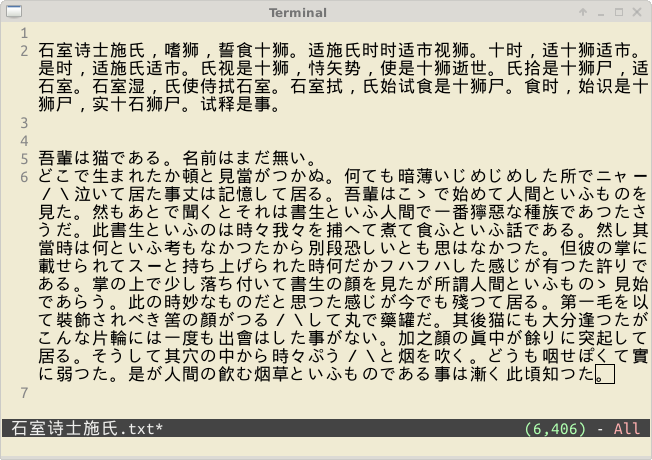
Chinese and Japanese input (double width characters):
.. image :: https://raw.githubusercontent.com/jonathanslenders/pyvim/master/docs/images/cjk.png?v2
Configuring pyvim
It is possible to create a .pyvimrc file for a custom configuration.
Have a look at this example: `pyvimrc
https://github.com/jonathanslenders/pyvim/blob/master/examples/config/pyvimrc`_
Limitations
Compared to Vi Improved, Pyvim is still less powerful in many aspects.
prompt_toolkitdoes not (or not yet) allow buffers to have an individual
cursor when buffers are opened in several windows. Currently, this results in
some unexpected behaviour, when a file is displayed in two windows at the
same time. (The cursor could be displayed in the wrong window and other
windows will sometimes scroll along when the cursor moves.) This has to be
fixed in the future.
- The data structure for a buffer is extremely simple. (Right now, it's just a
Python string, and an integer for the cursor position.) This works extremely
well for development and quickly prototyping of new features, but it comes
with a performance penalty. Depending on the system, when a file has above a
thousand lines and syntax highlighting is enabled, editing will become
noticable slower. (The bottleneck is probably the BufferControl code,
which on every key press tries to reflow the text and calls pygments for
- And this is Python code looping through single characters.)
- A lot of nice Vim features, like line folding, macros, etcetera are not yet
implemented. - Windows support is not that nice. It works, but could be improved. (I think
most Windows users are not that interested in this project, but prove me
wrong.)
Roadmap
There is no roadmap. I mostly implement the stuff which I need or interests me,
or which gives me the opportunity to learn. But feel free to create a GitHub
issue to request a new feature. Pull requests are also welcome. (Maybe create
an issue first to discuss it, if you're unsure whether I'll merge it.)
Maybe some day we will have a better data structure (Rope), that makes it
possible to open really large files. (With good algorithms, Python does not have
to be slower than C code.)
Maybe we will also have line folding and probably block editing. Maybe some
day we will have a built-in Python debugger or mouse support. We'll see. :)
Testing
To run all tests, install pytest:
pip install pytest
And then run from root pyvim directory:
py.test
To test pyvim against all supported python versions, install tox:
pip install tox
And then run from root pyvim directory:
tox
You need to have installed all the supported versions of python in order to run
tox command successfully.
Why did I create Pyvim?
There are several reasons.
The main reason is maybe because it was a small step after I created the Pythonprompt-toolkit library. That is a library which is actually only a simply
pure Python readline replacement, but with some nice additions like syntax
highlighting and multiline editing. It was never intended to be a toolkit for
full-screen terminal applications, but at some point I realised that everything
we need for an editor was in there and I liked to challenge its design. So, I
started an editor and the first proof of concept was literally just a few
hundred lines of code, but it was already a working editor.
The creation of pyvim will make sure that we have a solid architecture forprompt-toolkit, but it also aims to demonstrate the flexibility of the
- When it makes sense, features of
pyvimwill move back toprompt-toolkit, which in turn also results in a better Python REPL.
(see ptpython <https://github.com/jonathanslenders/ptpython>_, an alternative
REPL.)
Above all, it is really fun to create an editor.
Alternatives
Certainly have a look at the alternatives:
- Kaa: https://github.com/kaaedit/kaa by @atsuoishimoto
- Vai: https://github.com/stefanoborini/vai by @stefanoborini
- Vis: https://github.com/martanne/vis by @martanne
Q & A:
Q
Do you use curses?
A
No, it uses only prompt-toolkit.
Thanks
- To Vi Improved, by Bram Moolenaar. For the inspiration.
- To Jedi, pyflakes and the docopt Python libraries.
- To the Python wcwidth port of Jeff Quast for support of double width characters.
- To Guido van Rossum, for creating Python.
.. |Build Status| image:: https://api.travis-ci.org/jonathanslenders/pyvim.svg?branch=master

:target: https://travis-ci.org/jonathanslenders/pyvim#